This blog has recently moved to www.nutmegandanchovies.com. Please visit me there. :)
Wednesday, 20 February 2013

Saturday, 22 March 2008
Dhal and Hilsha
 I’ve been living in Bangladesh for six months now, and since my arrival haven’t written a single word about food. It’s not that I’ve stopped thinking about it. Indeed, I’m just as greedy as ever and I’d say that about thirty percent of my thoughts still centre on dinner, and another thirty goes for lunch and breakfast. It’s just that it’s hard to fully appreciate a national cuisine when every other meal seems determined to produce a serious bout of food poisoning.
Indeed, I’ve experienced just about every possible stomach upset imaginable since coming here. My colleagues at work are convinced that I’m not used to chilli or spices. They don’t seem to realise that Bangladesh does not have a world-wide spice monopoly. (Besides, on my second day in Bangladesh, a fellow AYAD dared me to pop a green chilli in one go – local style – and crunch it down as an after-dinner snack. It made me cry, but my stomach did not seem to be bothered.)
Instead, I think that I’m just not used to the bacteria levels of much Bengali food. Perhaps that’s because I try to forgo the protective layer of oil that seems to coat many dishes. You think I’m joking – but really one sometimes needs a whole role of paper towel to sop up the grease that sits on top of a bowl of dhal.
Even so, it’s not like I haven’t discovered some amazing food since I’ve been here. I’m a little addicted to shingara, the vegetable-filled fried pastries that we get most mornings for elevenses. I’ve also come to appreciate the art of “smashed” cuisine. There’s often nothing better than a hot paratha and fresh omelette for breakfast. The sweet ginger tea, that I sometimes get in the office of a DPHE official (instead of the usual condensed milk chai) is always a treat and has never made me sick.
So, I’ve resolved that for my last six months I will resume writing Nutmeg and Anchovies (although those two ingredients will be on a hiatus for a while). Until September, I’ll rename my blog: dhal and hilsha.
Wednesday, 12 September 2007
Fennel and Blood Orange Salad

It wasn’t really salad weather, but sometimes you just need something raw and crunchy. This salad was a cracker. Raw fennel is my new favourite salad base.
1 fennel bulb, sliced thinly
2 blood oranges, segmented with all pith removed
1/2 cup (of so) of green olives, sliced
several sploshes of olive oil
several splashes of apple cider vinegar
Toss thoroughly. The olives that we bought at the market had been marinated in some kind of Italian herb oil (with oregano and basil I think) which was not a bad idea.
Thursday, 9 August 2007
Cheat's Italian Part Two – Roast Veggie Lasagne
Cheaters' veggie lasagne is a favourite in our house. It’s never quite the same because the ingredients depend on what is going cheap and fresh at Lidl. The following is a list of the usual suspects: 

1 eggplant
2 red peppers
2 small zucchini (or courgettes, but I’m Australian after all)
1 large sweet potato or some pumpkin
a head of garlic
1 or 2 large mushrooms
You’ll also need:
a box of lasagne sheets
parmesan cheese
and a few other things (including anchovies and nutmeg) to make a red sauce:
1 onion (red or brown), sliced
1 bottle of passata, a tin of tomatoes or some simple red pasta sauce
an anchovy
whatever herbs you have lying around (usually dried oregano and bay leaves and fresh basil and thyme in my kitchen)
olive oil
and a béchamel sauce:
2 tablespoons butter
2 tablespoons flour
1 cup warm milk
gratted nutmeg
pepper
1-3 tablespoons of grated parmesan Slice the aubergine in 1 cm thick rounds; lay on a plate and sprinkle with salt. Leave to stand for 20 minutes; rinse and pat dry. Coat in olive oil and grill or roast in a hot oven, or fry on a ridged griddle, until soft. Turn once.
Bake the peppers whole on a tray in the middle of the oven at 180ºC, until the skin is black and the flesh is soft. Remove from the oven and place them directly into a ziplock plastic bag; this makes the peppers sweat. Remove from the bag after 10 minutes and peel off the skin with your fingers. Cut into fat strips.
Slice the zucchini in long rectangular strips. (It gets less soggy this way than it does in rounds.) Oil your hands and coat the slices. Grill in a hot oven, turning once, or fry on a ridged griddle until soft and char-lined.
Slice the mushroom in fat strips and fry in butter until soft.
Cut the pumpkin or sweet potato into 1 cm thick slices, coat in olive oil and roast in the oven at 180ºC. Remove from the oven, let cool a little and peel off the skin.
Break apart the head of garlic and roast the cloves whole in their skins. (This can be done on the same tray as the sweet potato, but the garlic will be ready first and should be removed from the oven when soft to touch.) Squeeze out the insides of the garlic and add to the red sauce.
Make the red sauce by frying the onion and garlic in some olive oil. Add the passata, tinned tomatoes or basic sauce. (Fresh tomatoes are also nice to add but you need to remove the skin by plunging them into boiling and then cold water first.) Add the anchovy, roasted garlic and whatever dried herbs are lying around. Simmer on low heat until any whole tomatoes have dissolved completely into sauce. Usually this just gets better the longer you cook it.
Make the béchamel by melting the butter in a small saucepan. Fry the flour in the butter, stirring constantly with a wooden spoon. Gradually add the milk and whisk to combine. Continue to stir until sauce simmers and thickens. Grate in some nutmeg and parmesan. Grind pepper to taste. 
Oil the bottom of a lasagne dish and cover with a layer of pasta. If the pasta sheets are the instant kind, you can use them raw; otherwise they will need to be plunged into boiling water for a minute or two first. (If the red sauce is very watery, there’s no need to pre-cook the lasagne sheets.) Spread over a layer of red sauce and cover with the aubergine and mushroom. Add another layer of pasta and cover with the sweet potato; cover and fill in the gaps with béchamel sauce. Add another layer of pasta, followed by red sauce and the remaining roasted vegetables. (Any number of layers of red sauce and veggies is fine but I prefer to have only one central layer of white sauce.) Finish with a final layer of pasta and top with the rest of the béchamel. Grate a fine layer of parmesan over the top. Bake in a moderate oven for 20-30 minutes, until the top has browned and the pasta is soft to cut.
Monday, 30 July 2007
Salted Potatoes
Mum reinvented the baked potato last night. Well not really. She used to do salted potatoes a lot, but you know how it is with food. You’ll make something every week for two months because it’s on your brain and everybody liked it the first time. Then you’ll forget about it for years because, well, there are newer and more exciting things to try.
Wash potatoes well and prick all over with a fork. Rub with coarsely ground salt. There’s no need to add oil as the moisture from the fork holes will help the salt to stick. Bake as usual directly on the rack in the centre of the oven. 
Wash potatoes well and prick all over with a fork. Rub with coarsely ground salt. There’s no need to add oil as the moisture from the fork holes will help the salt to stick. Bake as usual directly on the rack in the centre of the oven.
Thursday, 12 July 2007
Cheat's Italian Part One - Spaghetti
I’ve had some disgusting meals recently and many of them have been presented, in some for or other, under the label of “Italian cuisine”. Yet real Italian food bears no resemblance to the messes I have been offered. A cooking culture whose prime interest is in fresh ingredients prepared simply should inspire quick and lively meals. “Let’s grab an Italian tonight” is not a phrase that should send us running to the chilled ready-meals, the freezer or the local take-away. Yet this is precisely what I’ve experienced in the form of heat and serve pasta sauces, frozen lasagna and (shudder) dominos pizza. In response, I’ve decided on a three part set of cheaters' Italian recipes. While not straight out of a Neapolitan cookbook, these recipes are about fresh ingredients and are quick enough to prepare in the middle of the week.
Here are two favourite spaghetti sauce recipes. (There really is no excuse to reach for a bottle of red slop with the odd onion or mushroom slice thrown in.) The most important ingredient here is fresh basil, so buy a live plant and keep it on your window sill. With water only, it will last a month or two.
Firstly, please cook your pasta properly. Heat the water to a rolling boil and add a little salt. Cook the pasta only until it is just cooked through - 'al dente' if you want to pretend that you speak Italian. I often find that a minute less than the guide cooking time is a good way to go for UK packs.
LEMON BASIL SPAGHETTI
While your pasta is cooking, mix
a nob of butter
100 mls cream
1 tablespoon of lemon juice
in a small saucepan over low heat. (Don’t be tempted to add more lemon juice or it will sour and curdle - I tried it.) Stir until combined.
Drain you pasta but do not rinse, and leave a few tablespoons of cooking liquid sloshing around the bottom of the pan. Pour over the lemon mixture and add
the grated zest of 2 lemons
(Only take the yellow part of the lemon, as the white pith is bitter.)
Toss the pasta around and once it has cooled a little add
grated nutmeg
a handful of torn basil leaves
a handful of grated Parmesan.
(If you add the Parmesan while the pan is too hot, it will turn to a sticky glue on the bottom.)
Toss again and serve with extra basil and Parmesan scattered on top.
TOMATO BASIL SPAGHETTI
While the pasta is cooking, rub
a few hundred grams of small or cherry tomatoes in
olive oil.
Place on a baking tray with short sides under a hot grill. Give the tray a little shake after two minutes so that the tomatoes grill evenly. Once the tomatoes have split, released some juice and turned a little brown on the edges, remove from the oven.
Pour the tomatoes and the juices over the drained pasta. Add
another slosh of olive oil
a generous handful of fresh torn basil leaves
a handful of Parmesan.
Toss and serve.
Here are two favourite spaghetti sauce recipes. (There really is no excuse to reach for a bottle of red slop with the odd onion or mushroom slice thrown in.) The most important ingredient here is fresh basil, so buy a live plant and keep it on your window sill. With water only, it will last a month or two.
Firstly, please cook your pasta properly. Heat the water to a rolling boil and add a little salt. Cook the pasta only until it is just cooked through - 'al dente' if you want to pretend that you speak Italian. I often find that a minute less than the guide cooking time is a good way to go for UK packs.
LEMON BASIL SPAGHETTI
While your pasta is cooking, mix
a nob of butter
100 mls cream
1 tablespoon of lemon juice
in a small saucepan over low heat. (Don’t be tempted to add more lemon juice or it will sour and curdle - I tried it.) Stir until combined.
Drain you pasta but do not rinse, and leave a few tablespoons of cooking liquid sloshing around the bottom of the pan. Pour over the lemon mixture and add
the grated zest of 2 lemons
(Only take the yellow part of the lemon, as the white pith is bitter.)
Toss the pasta around and once it has cooled a little add
grated nutmeg
a handful of torn basil leaves
a handful of grated Parmesan.
(If you add the Parmesan while the pan is too hot, it will turn to a sticky glue on the bottom.)
Toss again and serve with extra basil and Parmesan scattered on top.
TOMATO BASIL SPAGHETTI
While the pasta is cooking, rub
a few hundred grams of small or cherry tomatoes in
olive oil.
Place on a baking tray with short sides under a hot grill. Give the tray a little shake after two minutes so that the tomatoes grill evenly. Once the tomatoes have split, released some juice and turned a little brown on the edges, remove from the oven.
Pour the tomatoes and the juices over the drained pasta. Add
another slosh of olive oil
a generous handful of fresh torn basil leaves
a handful of Parmesan.
Toss and serve.
Thursday, 5 July 2007
Black Pepper Chicken
 P recently made this wonderful chicken kali mirch and it was so good that I had to note it down. Here's what he did:
500 grams roughly cubed chicken breast or thigh
4 tablespoons whole black pepper corns
1 teaspoon turmeric
1/2 teaspoon salt
2 tablespoons ghee
3 cloves
15 dried curry leaves
1/2 cup chopped tomatoes
1 medium red onion sliced
1/2 teaspoon coriander powder
3 cloves of garlic chopped finely
1 cup water
Coarsely grind the pepper corns, turmeric and salt. (It is perfectly all right for some whole pepper corns to remain.) Mix this powder with the chicken and refrigerate for at least 1 hour. Heat the ghee in a wok; add the cloves, then the garlic and onion. Saute over a slow fire until the onion is tender and golden brown. Add the tomatoes and saute for about 15 minutes. Add the coriander powder and saute until the oil separates from the paste. Add the water and curry leaves. Once this sauce is boiling, add the chicken and cook covered. Once the chicken is cooked through, serve with basmati rice.
Compared to his usual dishes, this one was relatively quick to put together and is something that we will happily whip up mid-week or serve to friends. It seems like a lot of pepper but the curry leaves seem to cut that (adding an almost a sweet touch) and I just loved the pop of the whole pepper corns between the teeth.
Monday, 2 July 2007
Pain (au chocolat).
We've recently been on a search to find the best pain au chocolat in the Haymarket area. The following entry documents our systematic failure and final success:
 We first tried the new(ish) cafe on Dalry Road. Dolce Pasticceria is a lovely little place, despite the shop sign which looks like someone threw paint and wadded toilet paper at it. Unfortunately, their pain au chocolate matched the sign. It was terrible, so bad that we almost disqualified it from the competition. The Pasticceria offering was a "sort of" croissant, that had
  surreptitiously been sliced in half and spread with some form of nutella, several hours or days before. (The chocolate had formed a skin on the top side which prevented the two halves from truly sticking together.) The pastry was completely wrong. It was soft and dry with no hint of butter. The dough had formed air bubbles and a crust almost like a plain yeast bread and there were no flaky layers at all.
 Our second pain au chocolat was from Somerfield. We thought it best to try the supermarket at this point because nothing could look bad after our first entry and we hoped this would prevent any prejudice over it coming from a supermarket bakery. Somerfield's entry was
  surprising good. The pastry was flaky and buttery, although it had turned a little gluey under the chocolate. It tasted just a supermarket pain au chocolate from France. Supermarket isn't good enough though. It's not that we want the best pastry every; we're looking for something that you might find in any local village or suburban French bakery. Surely someone in Scotland can do it?
 Our third pain au chocolate came from the Bakehouse Cafe, opposite the Dalry Rd Sommerfield. Given that this cafe sports small French and Italian flags on the sign above the door, we entered with high hopes. Their entry looked rather like a small hedgehog as it had one small nub of chocolate poking out each end of a roll of pastry. The pastry was pretty lousy (check out the oily
 base) but the chocolate was probably the best thus far. There were big air pockets inside and the outside was hard and had gone all tough and crusty on the ends where the flour had obviously fried solid in the oven because of the excess fat. Obviously, the Auld Alliance did nothing for Edinburgh's bakers.
 Our final pain au chocolat (for this round at least) came from Le Marche Francais which is on West Maitland Street just around the corner from the Haymarket pub. This pastry was easily the best of the Haymarket area. It was light and crispy and the chocolate was soft and melty. It also came served with a short
  black and a french accent which I'm sure helps for a lot of people. I'm still not convinced that this pastry (or any of those that we might find in Scotland) matches up to the local bakery in Loperhet but we'll probably be running out to Le Marche Francais on weekend mornings from now on.
 We first tried the new(ish) cafe on Dalry Road. Dolce Pasticceria is a lovely little place, despite the shop sign which looks like someone threw paint and wadded toilet paper at it. Unfortunately, their pain au chocolate matched the sign. It was terrible, so bad that we almost disqualified it from the competition. The Pasticceria offering was a "sort of" croissant, that had
  surreptitiously been sliced in half and spread with some form of nutella, several hours or days before. (The chocolate had formed a skin on the top side which prevented the two halves from truly sticking together.) The pastry was completely wrong. It was soft and dry with no hint of butter. The dough had formed air bubbles and a crust almost like a plain yeast bread and there were no flaky layers at all.
Kate: 0 points; P: 0 points
 Our second pain au chocolat was from Somerfield. We thought it best to try the supermarket at this point because nothing could look bad after our first entry and we hoped this would prevent any prejudice over it coming from a supermarket bakery. Somerfield's entry was
  surprising good. The pastry was flaky and buttery, although it had turned a little gluey under the chocolate. It tasted just a supermarket pain au chocolate from France. Supermarket isn't good enough though. It's not that we want the best pastry every; we're looking for something that you might find in any local village or suburban French bakery. Surely someone in Scotland can do it?
Kate: 2.5 points; P: 3.5 points
 Our third pain au chocolate came from the Bakehouse Cafe, opposite the Dalry Rd Sommerfield. Given that this cafe sports small French and Italian flags on the sign above the door, we entered with high hopes. Their entry looked rather like a small hedgehog as it had one small nub of chocolate poking out each end of a roll of pastry. The pastry was pretty lousy (check out the oily
 base) but the chocolate was probably the best thus far. There were big air pockets inside and the outside was hard and had gone all tough and crusty on the ends where the flour had obviously fried solid in the oven because of the excess fat. Obviously, the Auld Alliance did nothing for Edinburgh's bakers.
 Kate: 2 points; P: 2.5 points
 Our final pain au chocolat (for this round at least) came from Le Marche Francais which is on West Maitland Street just around the corner from the Haymarket pub. This pastry was easily the best of the Haymarket area. It was light and crispy and the chocolate was soft and melty. It also came served with a short
  black and a french accent which I'm sure helps for a lot of people. I'm still not convinced that this pastry (or any of those that we might find in Scotland) matches up to the local bakery in Loperhet but we'll probably be running out to Le Marche Francais on weekend mornings from now on.
Kate: 3.5 points; P: 4 points
Look out for part 2 of pain (au chocolat) when we head out to explore suburban bakeries in other areas of Edinburgh.
Sunday, 24 June 2007
Tiramisu
 Inspired by our recent visit to Northern Italy, we decided to go Italian for a dinner with friends last weekend. It wasn't a dinner party for two reasons. Firstly, there were five of us and we only have two dinning chairs at the moment. Secondly, desert came out in a rather inelegant glass baking dish. Despite the awkward serving, it tasted great.
 I take my recipe from a wonderful book by Anna del Conte: The Concise Gastronomy of Italy. As usual, I don't quite follow her recipe because she recommends including small chunks of chocolate inside the tiramisu which are a little hard and lumpy for me. Also, her quantities of brandy and coffee aren't quite right: the last time I tried it I had to make up her coffee-mix three times for all the ladyfingers, which meant that I managed to get a rather greedy friend slightly drunk.
300 ml strong coffee I use plunger or run down to the local cafe for espresso
7 teaspoons brandy
80 grams dark chocolate (75%)
3 teaspoons cocoa powder
1/2 teaspoon cinnamon
3 large eggs yolks (or 4 small ones)
4 tablespoons caster sugar
250 grams mascarpone
2 large egg whites (or 3 small ones)
1 packet of Savoiardi or Lady-finger biscuits (bizarrely there were 19 in my pack)
Mix the coffee and brandy. Grate the chocolate.
Beat the egg yolks with the sugar into pale and soft peaks. Mix the mascarpone in a little at a  time, then beat until smooth. Whisk the egg whites to stiff and carefully fold into the egg mixture.
 time, then beat until smooth. Whisk the egg whites to stiff and carefully fold into the egg mixture.
Dip the biscuits into the coffee mixture and turn them over once only (otherwise they become too soggy). Lay the about 7 biscuits on the bottom of an oval dish. Spread over about 1/3 of the mascarpone egg mixture. Cover this layer in 1/3 of of grated chocolate. Layer with another 6 or 7 biscuits and another 1/3 of the mascarpone egg mixture and another 1/3 of the grated chocolate. Layer with the remaining biscuits and top with the remaining mascarpone egg cream. Cover with cling film and refrigerate for at least five hours.
Before serving, cover with the remaining grated chocolate. Mix the cinnamon and cocoa together and sift lightly over the top of the chocolate.
Peckhams stocks Savoiardi biscuts if you can't find them at the market.
Friday, 22 June 2007
Burger 'n' Shake
 When we go out for dinner during the week in Edinburgh, we usually head straight for a comfort food restaurant. For P, that means we go to Khushi's; for me, we head to Wannaburger. Last night, we tried out the new Wannaburger on Queensferry Street in the West End.
  (The first Wannaburger joint is on the Royal Mile.)
Wannaburger serves awesome shakes, just like the kind my Dad used to buy me when I was a kid. (I only wish that Wannaburger gave you the leftovers in the aluminium mixer cup along with your glass, the way they did at the Adelaide University Cellar.) An American friend told us that she comes all the way from St Andrews just for the peanut butter and banana shake. Yesterday, we went traditional with vanilla, which was really rich and frothy. (You can tastein the milk how rich the grass is at the moment.)
The burgers are as close to a summer barbecue as is possible for flat-dwelling people such as us. Usually, I go for "the classic" beef burger, which is always nice and pink in the middle. P had it this time and was not disappointed. I opted for the Bacon Guacamole burger as a salad. (All burgers are available without the bun and with extra greenery for the same price.) It was delicious, although the outside was a little "blacker" than usual. (OK, it was a little too dark, but the inside was still
 beautifully pink and who doesn't like a little charcoal now and then.) Calling for the bill, we finished up with the usual shot glass (or two) of peanut M&Ms. Perfect.
 "the classic" beef burger, which is always nice and pink in the middle. P had it this time and was not disappointed. I opted for the Bacon Guacamole burger as a salad. (All burgers are available without the bun and with extra greenery for the same price.) It was delicious, although the outside was a little "blacker" than usual. (OK, it was a little too dark, but the inside was still
 beautifully pink and who doesn't like a little charcoal now and then.) Calling for the bill, we finished up with the usual shot glass (or two) of peanut M&Ms. Perfect.
 Wannaburger is running a competition at the moment. They're asking customers to invent new recipe combinations for their burger menu.  Almost all burgers are based on their three "classic" burgers: a beef patty, a chicken breast and a bean patty, each served with salad, mayo and relish. Other ingredients - like guacamole and bacon - can be added according to choice; and this is where Wannacreate comes in. We suggested two new additions: a Surf'n'Turf (with a couple of king prawns) and a Boston Bean (with some good ole New England beans and a little Colby-style cheese). We're hoping they might make the menu, but that doesn't mean that next time we wouldn't order the "the classic" anyway.
 Almost all burgers are based on their three "classic" burgers: a beef patty, a chicken breast and a bean patty, each served with salad, mayo and relish. Other ingredients - like guacamole and bacon - can be added according to choice; and this is where Wannacreate comes in. We suggested two new additions: a Surf'n'Turf (with a couple of king prawns) and a Boston Bean (with some good ole New England beans and a little Colby-style cheese). We're hoping they might make the menu, but that doesn't mean that next time we wouldn't order the "the classic" anyway.
Sunday, 10 June 2007
Elephants and Bagels
 Well obviously! Where else would one go on a grey Sunday afternoon, accidentally caught on Nicholson Street and not feeling hungry enough for the mosque. The Elephant House is the Edinburgh institution, but it's smaller cousin set right next to Edinburgh University is a better bet during the tourist season.
There are all kinds of bagels to chose from - Plain, Poppy Seed, Garlic, Onion, Sesame, Rye, Olive & Sun Dried Tomato, Cheese & Jalapeno, Spinach - and a whole range of toppings. Today I went for the melted mozzarella, salami, pesto and sun-dried tomato on a sesame bagel. Bizarrely, all of the 'melted' cheese bagels are made by filling little paper cups (like the ones they give you you to rinse with at the dentist) with the grated cheese of your choice, zapping this in the microwave, and then spreading the resultant goo over your toasted bagel. To be fair, if you didn't see it done, you wouldn't be able to tell. The bagels taste great. The sun-dried tomato paste spread on mine was particularly good. I think though that I'd come back for a flavoured bagel slathered with cream cheese. (Can't beat a classic.)
Elephants and Bagels is at 37 Marshall Street, Nicholson square.
Thursday, 7 June 2007
Cinnamon Soup
In view of my recent declaration to include more cinnamon in savoury dishes, I knocked up this lentil soup yesterday. I'd tried a spicy lentil soup in Crete and the Edinburgh weather seemed suitably miserable for such wintery fare. Traditional recipes call for brown lentils, which I would have preferred as they keep their shape better, but I used red lentils as that's all that Somerfield ever has in stock. The following made up six large bowls of soup (and feed us for two lunches and one dinner, which is more than enough legumes for any person.)
4 cloves of garlic - smashed and chopped finely
4 small red onions - diced
2 large carrots - cubed
250 g red lentils
5 cups water
1 teaspoon dried thyme
1 teaspoon dried rosemary
2 bayleaves
1 cup passata (pureed tomato)
black pepper
1 teaspoon salt
1 teaspoon cinamon
Sweat the onions and garlic in some olive oil in the bottom of a pan. Add the carrots and cook for another minute or two. Pour in the lentils, water, pepper and dried herbs. Bring to the boil and simmer for 30 minutes or until the red lentils have disolved somewhat. Add the passata, salt and cinnamon and simmer for a further 20 minutes.
Remove the soup from the heat and stir in
1 tablespoon of olive oil
1 tablespoon of red wine vinegar
I like this soup for three reasons. 1) I kept to my resolution of abandoning the stock cube and it was still thick and tasty. 2) Cinnamon is good. 3) It only used dried herbs. While fresh herbs would probably have been more exciting, there are some days when you really don't want to trek to the market. (And, there is sometimes the problem of what happens to your window box of herbs when you're on holiday in Crete.)

4 cloves of garlic - smashed and chopped finely
4 small red onions - diced
2 large carrots - cubed
250 g red lentils
5 cups water
1 teaspoon dried thyme
1 teaspoon dried rosemary
2 bayleaves
1 cup passata (pureed tomato)
black pepper
1 teaspoon salt
1 teaspoon cinamon
Sweat the onions and garlic in some olive oil in the bottom of a pan. Add the carrots and cook for another minute or two. Pour in the lentils, water, pepper and dried herbs. Bring to the boil and simmer for 30 minutes or until the red lentils have disolved somewhat. Add the passata, salt and cinnamon and simmer for a further 20 minutes.
Remove the soup from the heat and stir in
1 tablespoon of olive oil
1 tablespoon of red wine vinegar
I like this soup for three reasons. 1) I kept to my resolution of abandoning the stock cube and it was still thick and tasty. 2) Cinnamon is good. 3) It only used dried herbs. While fresh herbs would probably have been more exciting, there are some days when you really don't want to trek to the market. (And, there is sometimes the problem of what happens to your window box of herbs when you're on holiday in Crete.)


Wednesday, 6 June 2007
Slower Food
Fraudulent May is usually thus accused because May weather pretends to be summer but is in fact winter wearing a yellow shirt. My May weather was much better, as I spent the month in sunny Crete. However, this has meant that May has fallen off the calender as far as this site is concerned.
 concerned.
This does not mean that I haven't been thinking about food. Far from it. I've been eating so much olive oil infused fare that I've probably gained several pounds. The food in Crete was amazing. While, I've long recognised the importance of the Slow Food movement in terms of sustaining small producers, I'm glad to discover that there are places where these kinds of organisations are unnecessary. In Crete, taverna owners also own fields where their vegetables are grown, their lamb is raised and rabbits are hunted.
The fish restaurant we frequented was run by a family whose son was a fisherman. The menu varied each day depending on his catch. Instead of the names of fish being presented on a blackboard, customers were invited into the kitchen to look at a the tray of today's offerings (kept in the fridge) and asked to choose exactly which fish it was that they wanted to try. The little red mullet, dipped in flour and fried whole, were so crispy and tasty that you could eat everything (including the fins) except for the head and back-bone.
My mother's favorite taverna George's and Georgia's (where she was allowed one day to roll dolmades in the kitchen), served rich and cinnamony rabbit stew, sweet and tender pork and wonderfully oily stuffed vegetables. (My skin feels so much better after my two weeks away. I can't decide if it was the olive oil, the sea or the weather that made the difference.) On our last day, we had the treat of perfectly ripe apricots fresh from Georgia's tree.
I'm determined to include more cinnamon in savoury dishes from now on and I'm less afraid of the amount of oil that a spongy aubergine is able to absorb. (I'm sure that is what Demeter, the Greek god of agriculture, made them for.) I hope also that I'll be able to expand my range of green vegetables. The field greens (Horta) which varied from taverna to taverna looked sometimes like wild spinach and sometimes like dandelion stems. I just hope that I can find some as interesting as those served in lemon juice at the Fenari Taverna.
Sunday, 13 May 2007
Search for the Green Papaya
Recently, P and I visited Ayutthaya, a Thai restaurant on Nicholson Street. I've been craving a green paw paw salad for about two years now. So, as we were passing, P nicked in to ask if it was on the Ayutthaya menu. He came out and winked. The waitress had assured him that green paw paw was available. We usually avoid east Asian food here because nothing can match that which is available to us at home, but the thought of crunchy papaya and sweet and salty dressing already had me salivating.
Unfortunately, the salad I ordered turned out to be a sort of coleslaw with fish sauce dressing. The carrot and cabbage mix failed to satisfy, despite the tasty dried shrimps and peanuts that accompanied it. So, I'm still on the look-out for a real paw paw salad and will be eternally grateful to anyone who can tell me where to find one in Scotland.
The rest of the meal was very pleasant. P's Tom yum soup was deliciously tangy, although was lacking the fistfuls of coriander that I like. The red curry was tasty but the only true glory of the whole meal was the rice. The sweet glutinous rice was served in a small grass basket. It was sticky (but not at all gluey)  and there was a slight chew left in each grain. Having been seeped in coconut milk (after cooking I think) it also smelt wonderful. Unlike other coconut flavored dishes, there was no coconut fat coating left in the mouth after eating. I think I might go back just for that rice!
 and there was a slight chew left in each grain. Having been seeped in coconut milk (after cooking I think) it also smelt wonderful. Unlike other coconut flavored dishes, there was no coconut fat coating left in the mouth after eating. I think I might go back just for that rice!
Ayutthaya has a website and is at 14b Nicolson Street.
Thursday, 3 May 2007
Birthday Books


April 24th was my birthday. Armed with a picnic lunch and intent on cycling to the Holy Isle, P and I caught the train to Berwick upon Tweed. Unfortunately, I sprained my ankle running for the train at Haymarket. By the time we reached Berwick, each malleaous ankle bump had transformed into a dent in the swollen purple grapefruit that now joined my foot to my leg. The cycle to Lindisfarne was replaced by a slow hobble around the city walls and lunch looking out to sea over the golf course. Walking back to the train station, we passed Berrydin Books, a second hand and remaindered bookseller. I limped through the door and soon spotted the cookery section.
Cookery sections in second hand bookstores and charity shops are rarely inspiring places, being generally stocked with encyclopedias of microwave gourmet that encourage the creation of entire Sunday lunches using only electromagnetic radiation. However, at Berrydin books I found a new set of titles from the Penguin Cookery Library. As a present to myself, I purchased the volumes Summer Cooking by Elizabeth David, English Food by Jane Grigson and A Celebration of Soup by Lindsey Bareham.
I've read the introduction to English Food and, while still a sceptic, I'm prepared to be convinced of the "wonderful inheritance" of English cooks. I've also read the introduction to the Bareham book, along with the first few sections on Stock-Making, Stock Recipes and Stock-pot Information. This book has so inspired me that I included a soup resolution in the usual list that I write on my birthday.
This year I will abandon stock-cubes and learn how to make quick and easy vegetable, poultry, red meat and fish stocks.
I think I might have to move to a flat with space for a fridge-freezer that is larger than a bread box.
Sunday, 22 April 2007
One’s favorite book is as elusive as one’s favorite pudding.

P and I have been flicking through our dictionary of quotations recently, in order to find choice quotes that we can write Amelie-style, in window chalk, on our living-room window. (The people at the bus-stop below look so miserable every morning that we thought they needed some poetic inspiration or at least some humorous prose.) A few days ago I found the E. M. Forster gem which gives today’s title. Given that I had spent the previous hour trying to work out what to make for dessert at a dinner party the next day, I remembered how true it is.
I went for sticky date pudding. While I wouldn't call sticky date my absolute favorite, it is right up there. Sticky date is probably the culinary equivalent of Jane Eyre on my favorite books list: sweet, dark and rich, but just a little too sugary at the end. Lacking an appropriate square tin, I made my puddings in muffin moulds which probably helps prevent the usual over-indulgent finale.
170 g stoned dates
1 teaspoon bicarbonate soda
300 ml boiling water
60 g unsalted butter
¾ cup brown sugar
2 eggs
170 g self-raising flour
½ teaspoon pure vanilla extract
Chop the dates and mix them with the bicarbonate soda. Pour over water, stir and leave to stand. (I left my dates for most of the afternoon. As that seems to break them up really well.)
Cream the butter and sugar. Add the eggs one at a time, beating after each. Fold in the flour. Gently stir in the date mixture and the vanilla.
Pour the mixture into 10 greased muffin moulds. Bake in a 180°C oven for 30 minutes.
When the puddings are nearly cooked, make the sauce.
400 g brown sugar
1 cup thick cream
250 g unsalted butter
½ teaspoon of pure vanilla extract (because I didn’t have a vanilla bean)
Bring all sauce ingredients to the boil. Reduce the heat and simmer for 5 minutes.
Once the puddings are cooked, use a butter knife to pop each pudding half-way out of its tin and spoon a little sauce underneath. Slip each pudding back into its tin and spoon more sauce over the tops. Return the tray to the oven for 2-3 minutes.
Serve with ice cream, cream and the remaining warm sauce.
Monday, 16 April 2007
Easter Cookies
The week before Easter, my mum and dad visited us in Edinburgh. As a present, my mum brought me four Easter cookie-cutters that she had picked up in Germany (where they had spent the previous month). She brought me a fat (woolly) sheep, a thin sheep with long legs, a leaping rabbit and an egg.
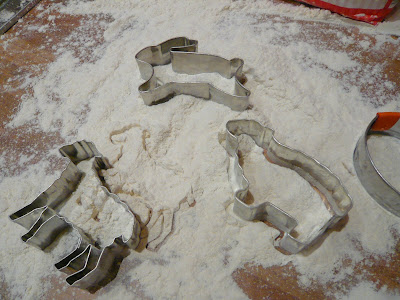
Hunting around online, I found a few recipes and this is the
350g pure icing sugar
2 egg whites
2 teaspoons lemon juice.
Beat together the egg whites and lemon juice.

Hunting around online, I found a few recipes and this is the
Sugar Cookie that I made to try out my cutters:
500g flour
¼ teaspoon salt
1 teaspoon baking powder
240g butter
300g white sugar
2 eggs
2 teaspoons vanilla extract
Cream together the butter and sugar until pale and fluffy. Beat in the eggs and vanilla extract.
In a separate bowl, whisk (or sieve) together the flour, baking powder and salt.
Add the dry ingredients to the wet mixture, one cupful at a time.
500g flour
¼ teaspoon salt
1 teaspoon baking powder
240g butter
300g white sugar
2 eggs
2 teaspoons vanilla extract
Cream together the butter and sugar until pale and fluffy. Beat in the eggs and vanilla extract.
In a separate bowl, whisk (or sieve) together the flour, baking powder and salt.
Add the dry ingredients to the wet mixture, one cupful at a time.
Stir until you have a smooth dough.
Divide the dough in half and place each lump onto a piece of plastic-wrap.
Refrigerate for at least one hour.
Preheat the oven to 180ºC.
Remove one half of the dough from the fridge and roll out, on a floured counter top, to a quarter-inch thickness.
Cut out cookies and lay on a baking-sheet covered in baking parchment.
Place each tray of cookies into the fridge for twenty minutes.
Bake the cookies for ten minutes.
Bake the cookies for ten minutes.
Leave to cool on the tray for a minute or so, before removing to a wire rack to cool.
I use the fingers of one hand to get the butter and sugar started, as I am often not organised enough to take the butter out of the fridge. Once roughly combined, I switch to a spoon to avoid melting the butter.
When refrigerating the dough for the first time, I press the lumps out into half-inch thick disks. This way the dough cools faster and more evenly.
Sugar cookies are not really very exciting. The icing is what makes the whole thing fun. This time I made white royal icing for flooding and used cocoa and different food colours for decorating. Quantities are rather inexact as I always seem to need more egg-whites and sugar than I expect I will.
A rough recipe for Royal Icing is:
When refrigerating the dough for the first time, I press the lumps out into half-inch thick disks. This way the dough cools faster and more evenly.
Sugar cookies are not really very exciting. The icing is what makes the whole thing fun. This time I made white royal icing for flooding and used cocoa and different food colours for decorating. Quantities are rather inexact as I always seem to need more egg-whites and sugar than I expect I will.
A rough recipe for Royal Icing is:
350g pure icing sugar
2 egg whites
2 teaspoons lemon juice.
Beat together the egg whites and lemon juice.
Slowly beat in the icing sugar (mixed with cocoa, if you want brown icing for brown bunnies) a little at a time, until the icing is the appropriate consistency.
Consistency
For outlining and decorating the cookies, the icing should form peaks in the bowl.
For flooding the cookies, test the consistency by lifting the spoon and dribbling icing back into the bowl. The trail of icing should sit on the surface for a few seconds, before disappearing back into the mix.
 I only have one piping bag, so I use baking-parchment to make icing cones. I find it easiest to fold a square of paper in half, then use the folded edge of the paper to form the point of the cone, by wrapping up and around at each side. I usually secure the cones with some tape. I also snip the smallest possible hole in the bottom and have a go on some paper before starting on the cookies.
I outlined and flooded the bunnies in white icing. Then I used coloured icing for the bows. On the sheep, I swirled the firmer icing in circles to look like wool and gave them bows too. The eggs were a bit of a mess: stripes, dots, squiggles and I even played with marbling (dipping cookies into flood-icing with food-dye only partially stirred through.) It was great fun, and extremely messy!
Sunday, 8 April 2007
Brinjal (noun): An Indian plant cultivated for its large edible, ovoid, glossy, usually purple-skinned fruit.
 Eggplant or aubergine, brinjal or baingan? Never mind what it's called, lots of men I know don’t seem to like this purple fruit very much. (Growing up, we ate moussaka and other eggplant favorites only on the nights that my Dad was out playing bridge.) Only Indian men seem to truly relish the eggplant. As the fruit is native to India, perhaps we had best look to that country for a tempting baingan recipe.
This evening, we made Baingan Bharta (Eggplant Mash), only we didn't just make one dish. We made the same dish twice, using exactly the same ingredients, but altering one cooking
technique.
The first step of every baigan bharta recipe is to cook the eggplant whole. This is done either by roasting the eggplant on a rack in a moderate oven or by sitting the eggplant directly on top of a gas burner. We’ve tried both in the past. Generally, P and I think that the cook top method is best. However, we decided to stage an objective test, so P invited Aashvin to dinner to be our blind judge. Aashvin sat in the lounge and watched The Apprentice while we cooked the following recipe in double quantities with each eggplant.
Ingredients:
1 egg plant
1 large onion – chopped
2 small tomatoes - chopped
2 green chillies – thinly sliced
1 tablespoon ginger - finely cut
1/4 tsp red chilli powder
1/2 tsp haldi/turmeric powder
1 tsp dhania/coriander powder
a handful of green peas (frozen is fine)
salt to taste
vegetable oil & ghee
fresh green coriander to garnish
Stage One
Eggplant 1
Place the whole eggplant on the centre tray of a moderate oven for 40-45 minutes. (You might want to stick a fork in a few times first, to avoid an aubergine explosion!)
 Eggplant 2
Place the whole eggplant directly onto the wire, above a middle-sized gas burner on moderate flame (see left). Rotate frequently, until the skin is black and flaky and the whole fruit is soft and mushy.
Stage Two
Let the eggplants cool slightly and then peel of the skin and roughly mash the flesh.
Stage Three
Saute the onion and the green chilies until soft. Add the dried turmeric, coriander and chili-powder and fry for another 2-3 minutes. Stir in the tomatoes and cook on a medium flame for 7-10 minutes. Stir in the brinjal. Stir in the peas. Garnish with fresh coriander.
 Aashvin was immediately able to pick the stove top brinjal (left). Indeed, it was vastly different to the oven-roasted dish (below). Not only did the stove version have a distinctive smoky taste, it was much sweeter than the other dish. (The oven-baked eggplant had a slightly bitter tang.) Surprisingly, the colour of the dishes was also quite different. While the oven-baked aubergine produced a greyish brown mash, the gas-cooked aubergine resulted in a golden coloured bharta. (How's the Hindi coming?)
Today, not only have I discovered a hithertoo unidentified link between lexemes and flavour, but I have come to one other conclusion:

Poor, poor people who only have electric cooktops.
If you’re in Edinburgh and looking for the ingredients used in the Baingan Bharta, I can recommend
Super Asian Foods (formerly PolyPack)
27 Jocks Lodge, Edinburgh, EH8 7AA
ph. 0131 661 4966
for ghee and all the necessary herbs and spices.
Friday, 30 March 2007
Abroath Smokies
My Lonely Planet guide to Scotland elects Abroath Smokies as Scotland's fourth most important Scottish attraction. That means that before you visit Edinburgh’s old town, before you tour Stirling Castle, before you sip whiskey in a Hebridean distillery or play a round of golf at St Andrews, you should consume an Abroath Smokie.
 An Abroath Smokie is a haddock, traditionally smoked over a hard-wood fire. Gutted at sea, the fish are transported to the smoke-house where the first stage of the process is to head and clean the fish. The fish are then salted and packed into barrels (and left overnight). After salting, the fish are washed and their tails are tied together in pairs. The pairs of fish are slung over wooden sticks and suspended over a whiskey barrel, lined with slate to protect from the slow fire of oak and beech. Hessian sacking is placed over the fish, allowing sufficient oxygen to sustain the fire whilst retaining heat and smoke around the fish. Smoking time is usually 30 to 40 minutes.

Last Saturday, Iain R. Spink's Original Smokies from Abroath had a stall at the Edinburgh Farmers market. I usually wander over to Queens Street on a Saturday morning to check out the stalls and breath in the smell of the Roast Crackling from the Reiver Country Farm Foods Stand (although that’s another entry). Other than the Pork smell, the market is often slightly disappointing; the range of produce is sometimes quite limited, excepting an eternal plethora of sausages. This week, the market was wonderfully busy. It was obviously the on-week for most traders, including the elusive Abroath Smokies company. As soon as I turned onto Bread Street, the air had a wood-fire flavour and any thoughts of crackling and apple sauce were forgotten.
 Abroath Smokies had set up a row of smoking fires along the verge of Castle Terrace. Freshly smoked fish were cooling on a park bench. The fish had been filleted once they were out of the smoke and all the bones were tossed in a large bin. On other benches and garden edging around the stand, were dozens of people picking the very last flakes from the skin of their smokies. I bought two smokies. I pulled a flake of white flesh from the tail of one (just to have tried it when hot!) then wrapped them up again to have for dinner. The fish was so delicious and so delicate that I was quite tempted to sit down in the middle of Johnston Terrace and eat them both, despite having had a huge breakfast an hour before.
I did reach into my bag for a second flake about half way up to the Old Town, where I was going to meet Hattie. My hand came out of my bag covered in clear, warm juice. The fish were leaking all over the place. I pulled out my wallet, my diary, my camera and my phone, all of which were covered in a sweet sticky liquid. (I know it was sweet because I had a good lick of my fingers!) I then retrieved the fish bag, which continued to drip all over my boots. I really needed something to sop everything up and I badly needed to wash my hands and my phone! I thought of going into the Ness shop to ask for a bag, but I figured that they wouldn’t be very obliging after I’d dribbled smokey fish juice all over their floor. I called Hattie (getting a sticky ear in the process) and asked her pick up a plastic bag and a newspaper for me to wrap the fish in. Thanks to Hattie, the Saturday Scotsman, a granite bench in Tron Square and the teeny tiny bathroom of the Southern Cross Cafe, I was soon cleaned up. (My keys and phone still smell a bit smokey though.)
P and I ate the fish cold for dinner with rocket and shaved parmesan on the side. They were just as good as they had been in the morning – sweet, smokey and salty like the sea. Delish!
I agree with the Rough Guide about the number four attraction in Scotland and would recommend that all visitors to the country try an Abroath Smokie.
 An Abroath Smokie is a haddock, traditionally smoked over a hard-wood fire. Gutted at sea, the fish are transported to the smoke-house where the first stage of the process is to head and clean the fish. The fish are then salted and packed into barrels (and left overnight). After salting, the fish are washed and their tails are tied together in pairs. The pairs of fish are slung over wooden sticks and suspended over a whiskey barrel, lined with slate to protect from the slow fire of oak and beech. Hessian sacking is placed over the fish, allowing sufficient oxygen to sustain the fire whilst retaining heat and smoke around the fish. Smoking time is usually 30 to 40 minutes.
Last Saturday, Iain R. Spink's Original Smokies from Abroath had a stall at the Edinburgh Farmers market. I usually wander over to Queens Street on a Saturday morning to check out the stalls and breath in the smell of the Roast Crackling from the Reiver Country Farm Foods Stand (although that’s another entry). Other than the Pork smell, the market is often slightly disappointing; the range of produce is sometimes quite limited, excepting an eternal plethora of sausages. This week, the market was wonderfully busy. It was obviously the on-week for most traders, including the elusive Abroath Smokies company. As soon as I turned onto Bread Street, the air had a wood-fire flavour and any thoughts of crackling and apple sauce were forgotten.
 Abroath Smokies had set up a row of smoking fires along the verge of Castle Terrace. Freshly smoked fish were cooling on a park bench. The fish had been filleted once they were out of the smoke and all the bones were tossed in a large bin. On other benches and garden edging around the stand, were dozens of people picking the very last flakes from the skin of their smokies. I bought two smokies. I pulled a flake of white flesh from the tail of one (just to have tried it when hot!) then wrapped them up again to have for dinner. The fish was so delicious and so delicate that I was quite tempted to sit down in the middle of Johnston Terrace and eat them both, despite having had a huge breakfast an hour before.
I did reach into my bag for a second flake about half way up to the Old Town, where I was going to meet Hattie. My hand came out of my bag covered in clear, warm juice. The fish were leaking all over the place. I pulled out my wallet, my diary, my camera and my phone, all of which were covered in a sweet sticky liquid. (I know it was sweet because I had a good lick of my fingers!) I then retrieved the fish bag, which continued to drip all over my boots. I really needed something to sop everything up and I badly needed to wash my hands and my phone! I thought of going into the Ness shop to ask for a bag, but I figured that they wouldn’t be very obliging after I’d dribbled smokey fish juice all over their floor. I called Hattie (getting a sticky ear in the process) and asked her pick up a plastic bag and a newspaper for me to wrap the fish in. Thanks to Hattie, the Saturday Scotsman, a granite bench in Tron Square and the teeny tiny bathroom of the Southern Cross Cafe, I was soon cleaned up. (My keys and phone still smell a bit smokey though.)
P and I ate the fish cold for dinner with rocket and shaved parmesan on the side. They were just as good as they had been in the morning – sweet, smokey and salty like the sea. Delish!
I agree with the Rough Guide about the number four attraction in Scotland and would recommend that all visitors to the country try an Abroath Smokie.
Whirlwind visitors might have a hard time getting one though. Unless your Highland's tour stops in Abroath, the only other option is to visit Iain R. Spink at one of Scotland's farmers markets. It is particularly difficult to catch them at the Edinburgh Farmers market as they only come to Edinburgh on the fourth Sunday of the month, if, and only if, there are five Sundays in the month. By my calculations that is about two times in the year.
Other market locations for Original Smokies from Abroath can be found on their website.
Other market locations for Original Smokies from Abroath can be found on their website.
Wordsworth Biscuits
Morning tea hasn’t happened in my house for a while. We’ve had plenty of afternoon teas. We’ve had cakes and scones and sandwiches. We’ve had cookies, but they’ve been big fat cookies, the kind of cookies that are good to munch during a long night in, at the end of an otherwise too small lunch, or in response to the hunger pangs that arise on the walk home from school. So today I made hazelnut biscuits, perfect for placing on the saucer next to a cup of tea or good coffee.
 The recipe I adapted from Stephanie Alexander The Cook's Companion. She calls for thinly sliced candied peel to be added but I switched for dried cranberries (as below) and increased the quantity of ground hazelnut and decreased the almond meal of the original recipe.
2 eggs
200 grams castor sugar
a few drops of vanilla essence
1 teaspoon ground cinnamon
60 grams chopped dried cranberries (although perhaps not chopped next time)
180 grams ground hazelnuts
120 grams ground almonds
½ teaspoon baking powder
Beat eggs, castor sugar and vanilla until the batter is paler than when your started and it is coat-the-back-of-a-spoon thick. Fold in remaining ingredients. Using a piping bag with no nozzle, pipe the mixture in fingers onto baking trays line with paper. Bake for 30 minutes in a 140º C oven. Once out of the oven dibble a thin icing made from:
1 cup pure icing sugar
juice of one lemon
The original recipe did call for the egg and sugar batter to be beaten until ‘pale and thick’. This instruction lead me to a quarter hour of frenzied beating but the batter never would get as thick as I thought it should – nowhere near as thick as egg yolks will go if they are beaten alone. Hopefully my instruction, while less elegant, may help avoid any extraneous beating. Candied peel might give a more exciting tang to the biscuit but I never really like peel. Cranberries certainly add a similar sour flavour, and a somewhat Christmassy look, but perhaps fresh peel might be a nice change next time.
The amoretti biscuit that one occasionally receives with coffee at an Italian cafe always fill me with happiness. When I see them. When I eat them, I often find that they are dry, over-crumbly and contain too much almond extract or they are just too small. Wordsworth biscuits are much more satisfying but still light enough for a morning tea. Also, compared to some of those other almond biscuits, these are really, really easy to make.
 The recipe I adapted from Stephanie Alexander The Cook's Companion. She calls for thinly sliced candied peel to be added but I switched for dried cranberries (as below) and increased the quantity of ground hazelnut and decreased the almond meal of the original recipe.
2 eggs
200 grams castor sugar
a few drops of vanilla essence
1 teaspoon ground cinnamon
60 grams chopped dried cranberries (although perhaps not chopped next time)
180 grams ground hazelnuts
120 grams ground almonds
½ teaspoon baking powder
Beat eggs, castor sugar and vanilla until the batter is paler than when your started and it is coat-the-back-of-a-spoon thick. Fold in remaining ingredients. Using a piping bag with no nozzle, pipe the mixture in fingers onto baking trays line with paper. Bake for 30 minutes in a 140º C oven. Once out of the oven dibble a thin icing made from:
1 cup pure icing sugar
juice of one lemon
The original recipe did call for the egg and sugar batter to be beaten until ‘pale and thick’. This instruction lead me to a quarter hour of frenzied beating but the batter never would get as thick as I thought it should – nowhere near as thick as egg yolks will go if they are beaten alone. Hopefully my instruction, while less elegant, may help avoid any extraneous beating. Candied peel might give a more exciting tang to the biscuit but I never really like peel. Cranberries certainly add a similar sour flavour, and a somewhat Christmassy look, but perhaps fresh peel might be a nice change next time.
The amoretti biscuit that one occasionally receives with coffee at an Italian cafe always fill me with happiness. When I see them. When I eat them, I often find that they are dry, over-crumbly and contain too much almond extract or they are just too small. Wordsworth biscuits are much more satisfying but still light enough for a morning tea. Also, compared to some of those other almond biscuits, these are really, really easy to make.
Subscribe to:
Posts (Atom)


